SOD1-Linked ALS — AI-Assisted Variant Comparison
Research ownership & attribution: Rami M. Alkhaleeli — Alkhaleeli BioAI LLC
Scientific Concept
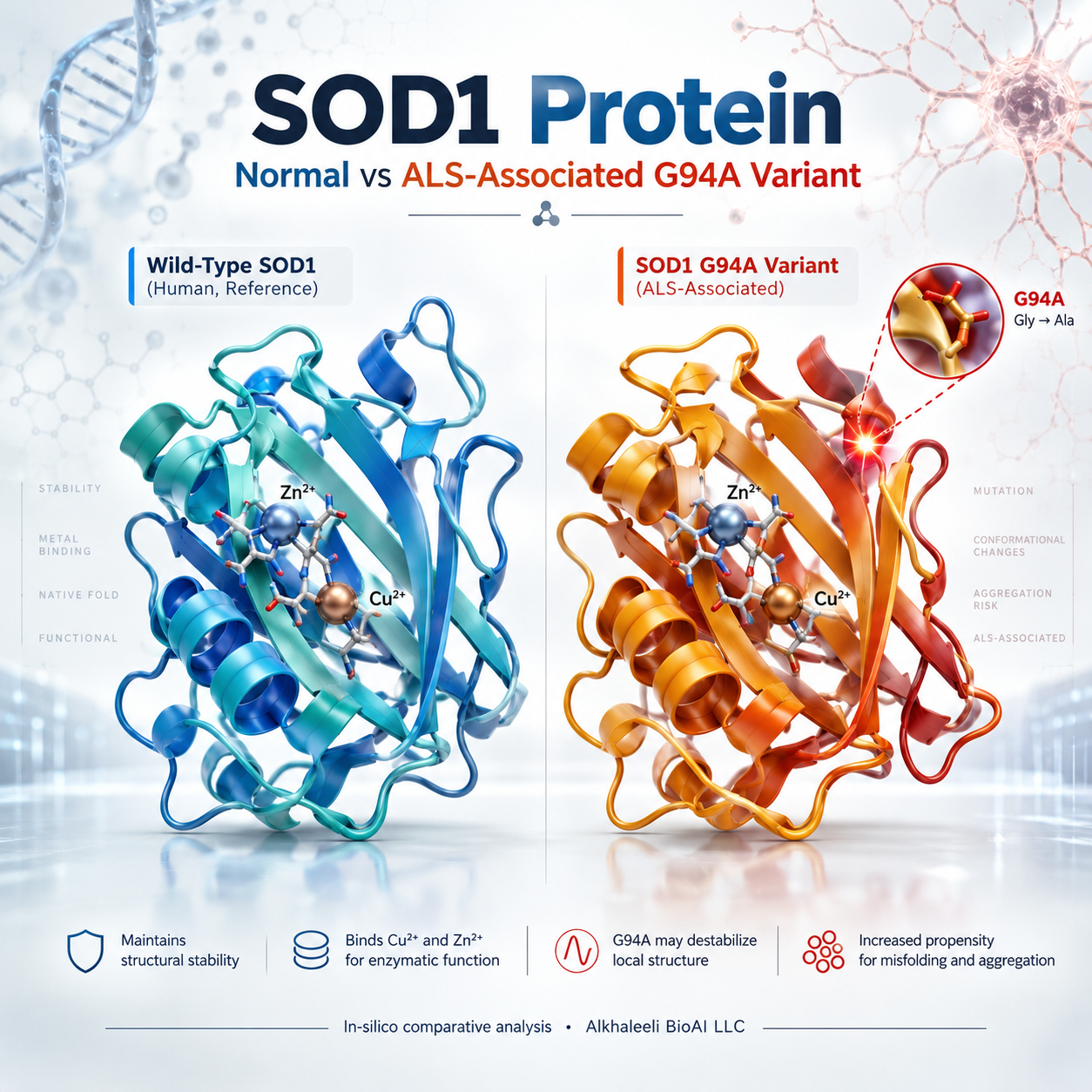
Superoxide dismutase 1 (SOD1) protects human cells from oxidative damage by converting harmful superoxide radicals into less reactive molecules, using copper and zinc ions that support its enzymatic function and structural stability. One ALS-associated genetic variant, G94A (also written G93A), replaces a single amino acid: glycine (G) becomes alanine (A). Although this change appears small, it can affect the protein's molecular behavior, stability and tendency to misfold — and misfolded SOD1 proteins can accumulate and contribute to cellular dysfunction, particularly in motor neurons. For SOD1-associated ALS, pathogenic SOD1 can be toxic: merely producing additional healthy protein via mRNA may not eliminate toxicity. Clinically, FDA-approved tofersen works by lowering SOD1 protein production, and other mutation-specific and protein-degradation strategies are under investigation. This research concept asks whether an open-source SOD1 sequence comparison can help distinguish plausible RNA-based therapeutic strategies for this genetic form of ALS.
Scientific Diagram
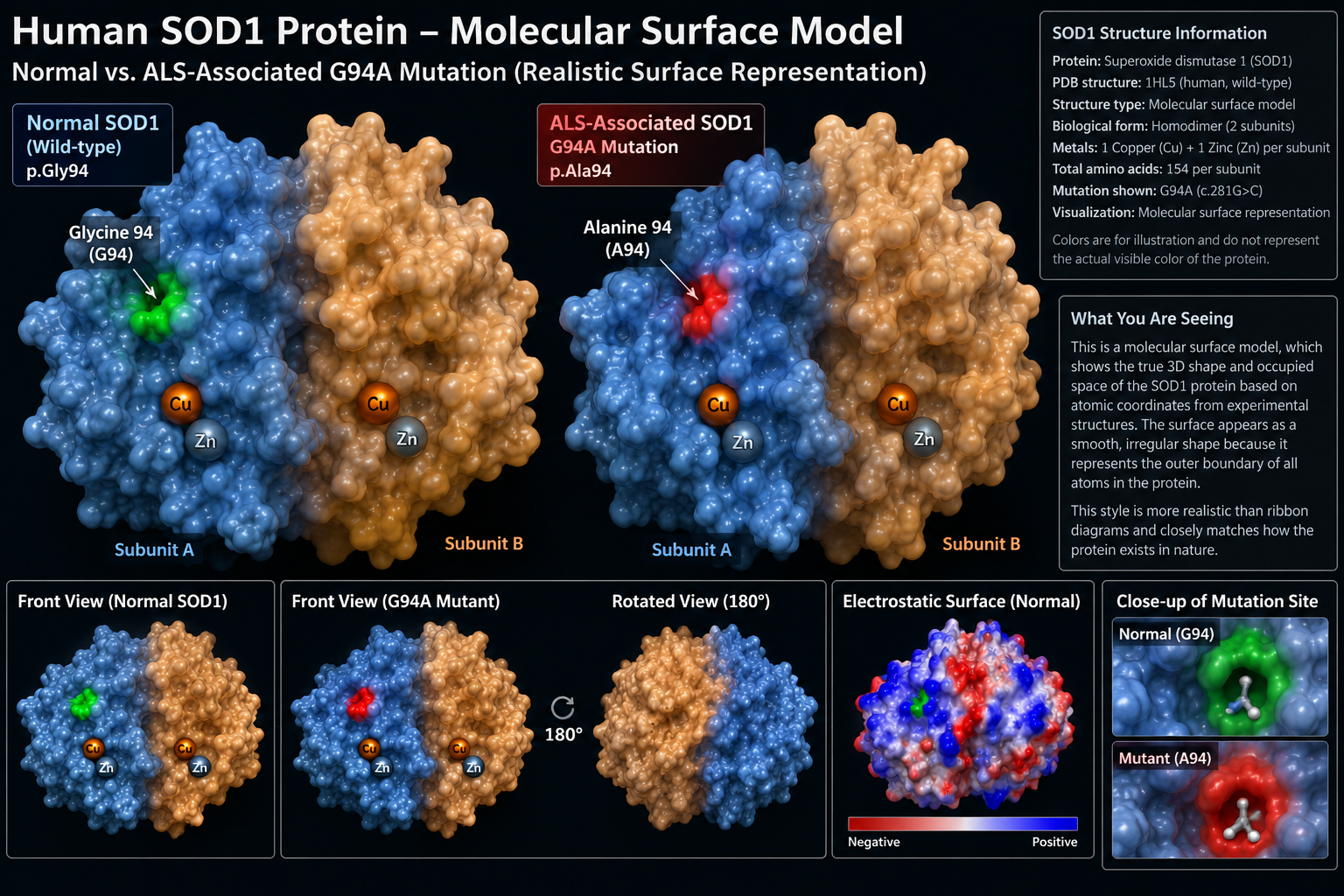
Original uploaded scientific infographic — use the Enlarge button for a full-size view.
Design Process
- 1
Reference sequence review — a user-supplied human SOD1 reference transcript labelled NM_000454.5 is reviewed.
- 2
Documented variant reconstruction — an in-silico reconstruction of the documented pathogenic ALS variant c.281G>C (p.Gly94Ala) is generated.
- 3
Python nucleotide/protein comparison — the two 895-nucleotide transcripts are compared: they differ by one base, and the translated 154-residue proteins differ at position 94 (glycine to alanine). This simulated example is not a patient sequence.
- 4
Evidence-based ranking of therapeutic mechanisms — RNA-based strategies (e.g., lowering SOD1 production vs. replacing it with healthy protein) are ranked against the mutation mechanism.
- 5
Transparent limitations and validation needs — outputs are explicitly labelled research concepts with no patient information and no asserted experimental efficacy results.
Proposed Biological Mechanism
- 1
SOD1 normally converts harmful superoxide radicals into less reactive molecules, supported by copper (Cu) and zinc (Zn) ions bound in each subunit.
- 2
The G94A substitution (glycine → alanine at position 94) is modeled to alter local molecular behavior.
- 3
Altered behavior is proposed to affect protein stability and increase the tendency to misfold.
- 4
Misfolded SOD1 proteins are proposed to accumulate and contribute to cellular dysfunction, particularly in motor neurons.
- 5
Understanding how SOD1 mutations contribute to ALS is proposed to help identify potential molecular targets for future therapeutic research — a research direction only, not an experimentally demonstrated mechanism.
All steps describe intended, modeled or proposed behavior — no effect above is experimentally proven or clinically demonstrated.
Mathematical Analysis
Transcript length
895 nt
Both compared transcripts (reference NM_000454.5 and the reconstructed variant) are 895 nucleotides long.
Sequence difference
1 base
The two transcripts differ by exactly one nucleotide: c.281G>C.
Protein length
154 residues
Both translated proteins are 154 amino acids long.
Mutation position
Position 94 · Gly → Ala
The single amino-acid change: glycine (G) to alanine (A) at position 94 (p.Gly94Ala, also written G93A).
Metal ions per subunit
1 Cu + 1 Zn
SOD1 binds one copper and one zinc ion per subunit to support enzymatic function and structural stability.
Biological form
Homodimer (2 subunits)
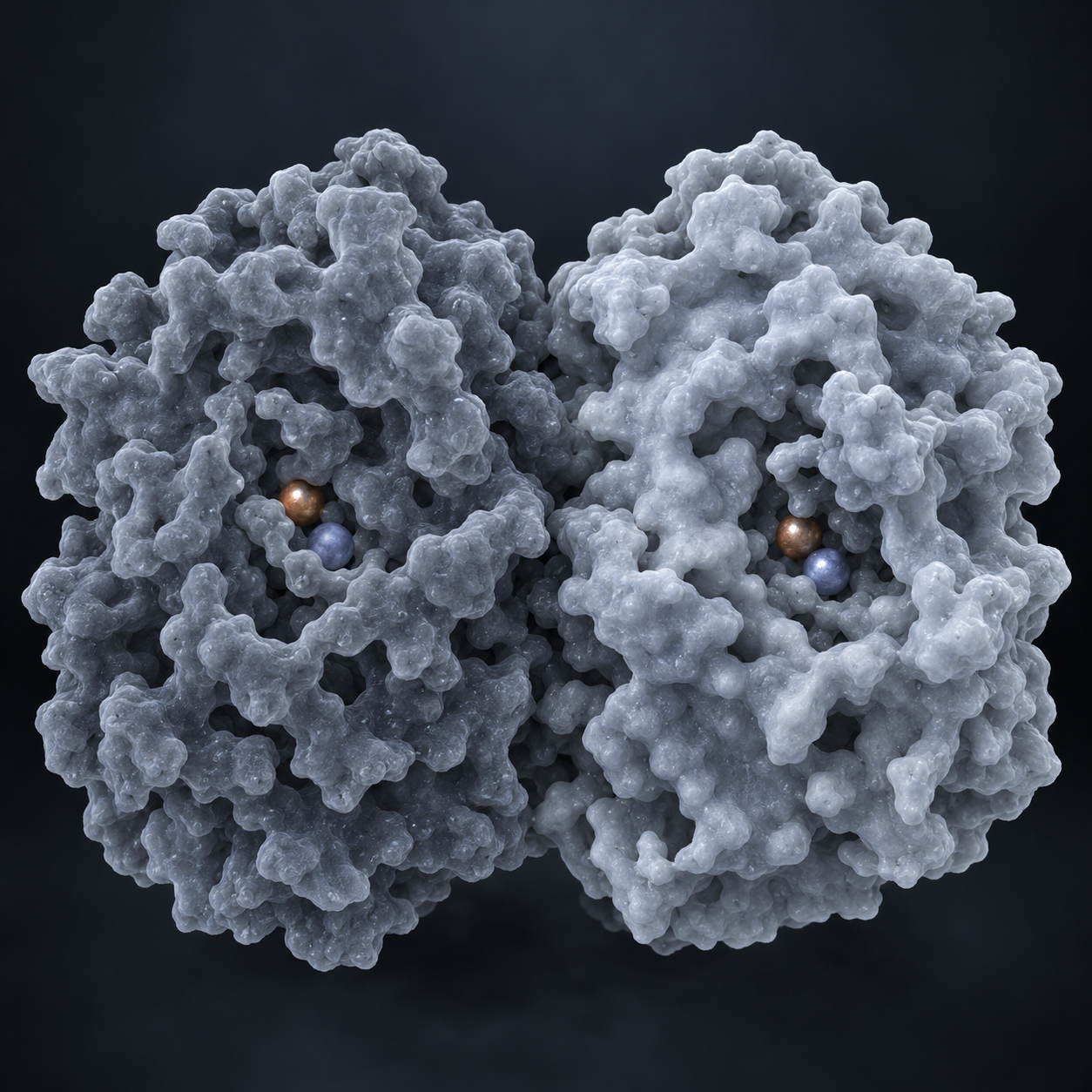
SOD1 functions as a homodimer of two subunits (PDB structure 1HL5, human wild-type).
Predicted HLA population coverage is a computational prediction of epitope presentation — it is not a measure of actual vaccine protection. All values originate from the supplied manuscript materials.
FASTA Sequence Viewer
Complete sequence not available
No sequence files are published for this case study — it is presented as a simulated example, not a patient sequence. Sequences are never generated as replacements — the original sequence files remain private until the author authorizes public access.
Original Scientific Manuscript
Manuscript — Private by default
No manuscript PDF is published for this case study. The open-access research summary is available on Zenodo via the external link below. No patient information or experimental efficacy results are asserted.
Request manuscript access via the collaboration contactScientific Status
SOD1-Linked ALS — Research concept — in-silico case study
Open-access ALS computational research on ZenodoThese projects are scientific research designs and computational proof-of-concept studies. They are not approved medical products, experimentally validated cures, or guarantees of therapeutic effectiveness.