Animal-Free LC-MS Endotoxin & Microbial Detection
Research ownership & attribution: Rami M. Alkhaleeli — Alkhaleeli BioAI LLC
Scientific Concept
Traditional endotoxin and pyrogen testing relies on animal-derived reagents (e.g., Limulus amebocyte lysate). This design proposes an animal-free, chemistry-based alternative: microbial contamination is detected and classified by its molecular markers — Lipid A / LPS from Gram-negative bacteria, peptidoglycan and muramic acid derivatives from Gram-positive bacteria, and chitin / β-glucan fragments from fungi — using lysis, solid-phase extraction cleanup and high-resolution liquid chromatography–mass spectrometry (LC-MS). The analytical target is the set of microbial-specific molecular markers in pharmaceutical, process or environmental samples.
Scientific Diagram
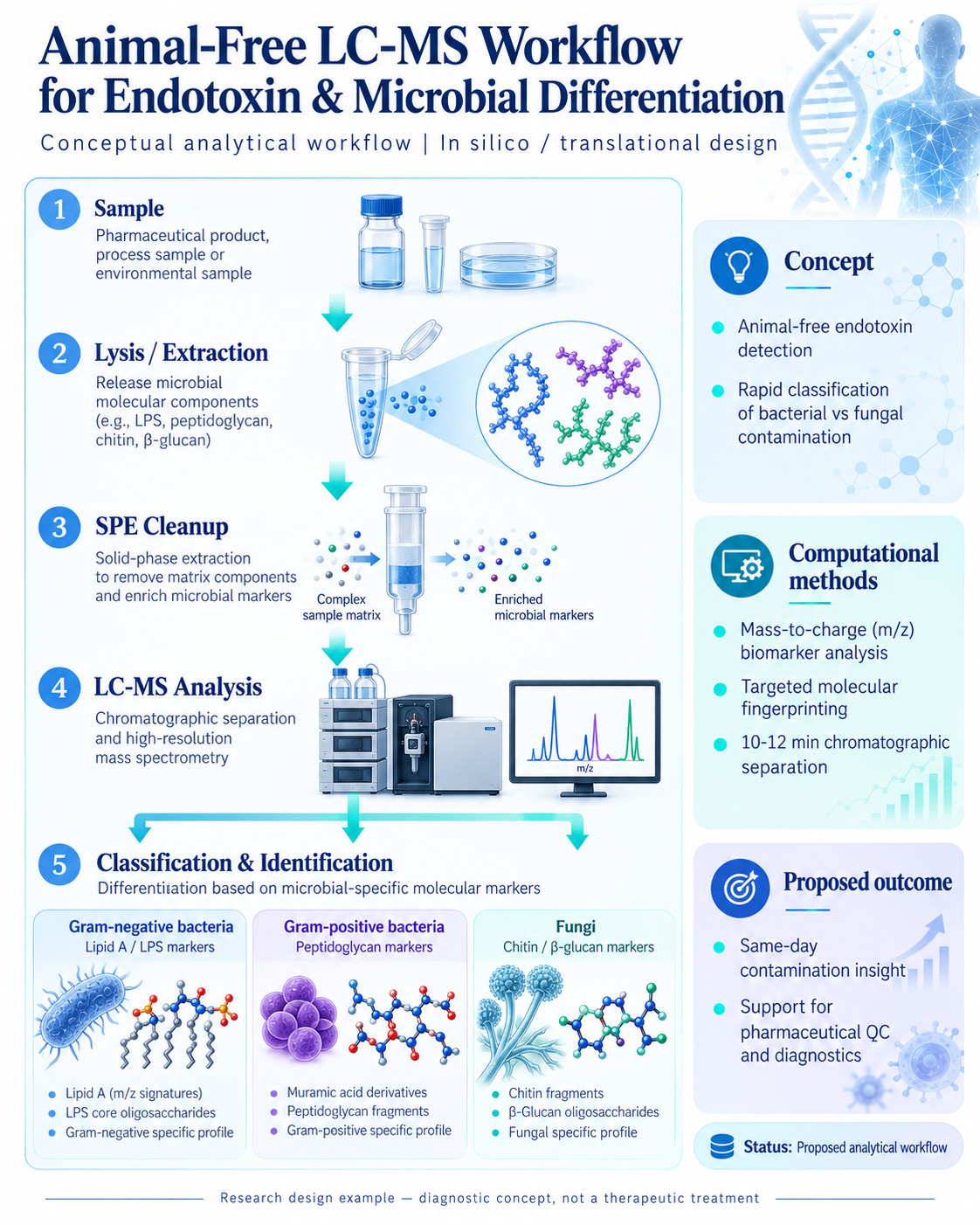
Original uploaded scientific infographic — use the Enlarge button for a full-size view.
Design Process
- 1
Sample — pharmaceutical product, process sample or environmental sample collection.
- 2
Lysis / extraction — release microbial molecular components (e.g., LPS, peptidoglycan, chitin, β-glucan).
- 3
SPE cleanup — solid-phase extraction removes matrix components and enriches microbial markers from the complex sample matrix.
- 4
LC-MS analysis — chromatographic separation and high-resolution mass spectrometry.
- 5
Classification & identification — differentiation based on microbial-specific molecular marker profiles (Gram-negative, Gram-positive or fungal).
Proposed Biological Mechanism
- 1
The sample is lysed to release microbial molecular components.
- 2
Solid-phase extraction cleans the matrix and enriches the microbial markers.
- 3
LC-MS separates the enriched markers and records accurate mass-to-charge (m/z) signatures.
- 4
Lipid A / LPS signatures indicate Gram-negative bacteria; muramic acid and peptidoglycan fragments indicate Gram-positive bacteria; chitin and β-glucan fragments indicate fungi.
- 5
The classified marker profile gives same-day contamination insight and supports pharmaceutical QC and diagnostics (proposed workflow — analytical concept, not a validated diagnostic method).
All steps describe intended, modeled or proposed behavior — no effect above is experimentally proven or clinically demonstrated.
Mathematical Analysis
Lipid A / LPS marker range (Gram-negative)
m/z ~1400–1800
Proposed diagnostic ion range for Lipid A / LPS fragments, used to indicate Gram-negative bacteria instead of a clotting-based assay.
Chromatographic separation window
10–12 min
Proposed LC separation step that separates lipids, sugars and peptides before targeted high-resolution MS detection.
Result classes
Bacterial / Fungal / Mixed
A panel of diagnostic ions would assign pass/fail for endotoxin and a bacterial, fungal or mixed classification. This is a proposed workflow, not a validated diagnostic method.
Predicted HLA population coverage is a computational prediction of epitope presentation — it is not a measure of actual vaccine protection. All values originate from the supplied manuscript materials.
FASTA Sequence Viewer
Complete sequence not available
Complete sequence not available in the supplied manuscript. Sequences are never generated as replacements — the original sequence files remain private until the author authorizes public access.
Original Scientific Manuscript
Read-only viewing
The original manuscript PDF is available below for read-only viewing only. Downloading, copying or redistribution is not permitted without written permission from Alkhaleeli BioAI LLC.
© Alkhaleeli BioAI LLC. All rights reserved. This manuscript is the intellectual property of Alkhaleeli BioAI LLC and is provided for read-only viewing only. Downloading, copying, printing, redistribution, or any other use — in whole or in part — requires prior written permission from Alkhaleeli BioAI LLC.
Scientific Status
Animal-Free LC-MS Endotoxin & Microbial Detection — Proposed analytical workflow
These projects are scientific research designs and computational proof-of-concept studies. They are not approved medical products, experimentally validated cures, or guarantees of therapeutic effectiveness.