Hunter Syndrome — IDS mRNA Therapeutic Design
Research ownership & attribution: Rami M. Alkhaleeli — Alkhaleeli BioAI LLC
Scientific Concept
Hunter syndrome (mucopolysaccharidosis II) is caused by loss-of-function mutations in the IDS gene, leading to deficient or absent iduronate-2-sulfatase enzyme and accumulation of glycosaminoglycans (GAGs) in lysosomes. The molecular target is the IDS enzyme itself: this computational framework designs an optimized, non-replicating mRNA encoding functional human IDS, delivered in lipid nanoparticles (LNPs), with the goal of temporary mRNA-based IDS expression to reduce GAG buildup — a research framework, not a validated therapy.
Scientific Diagram
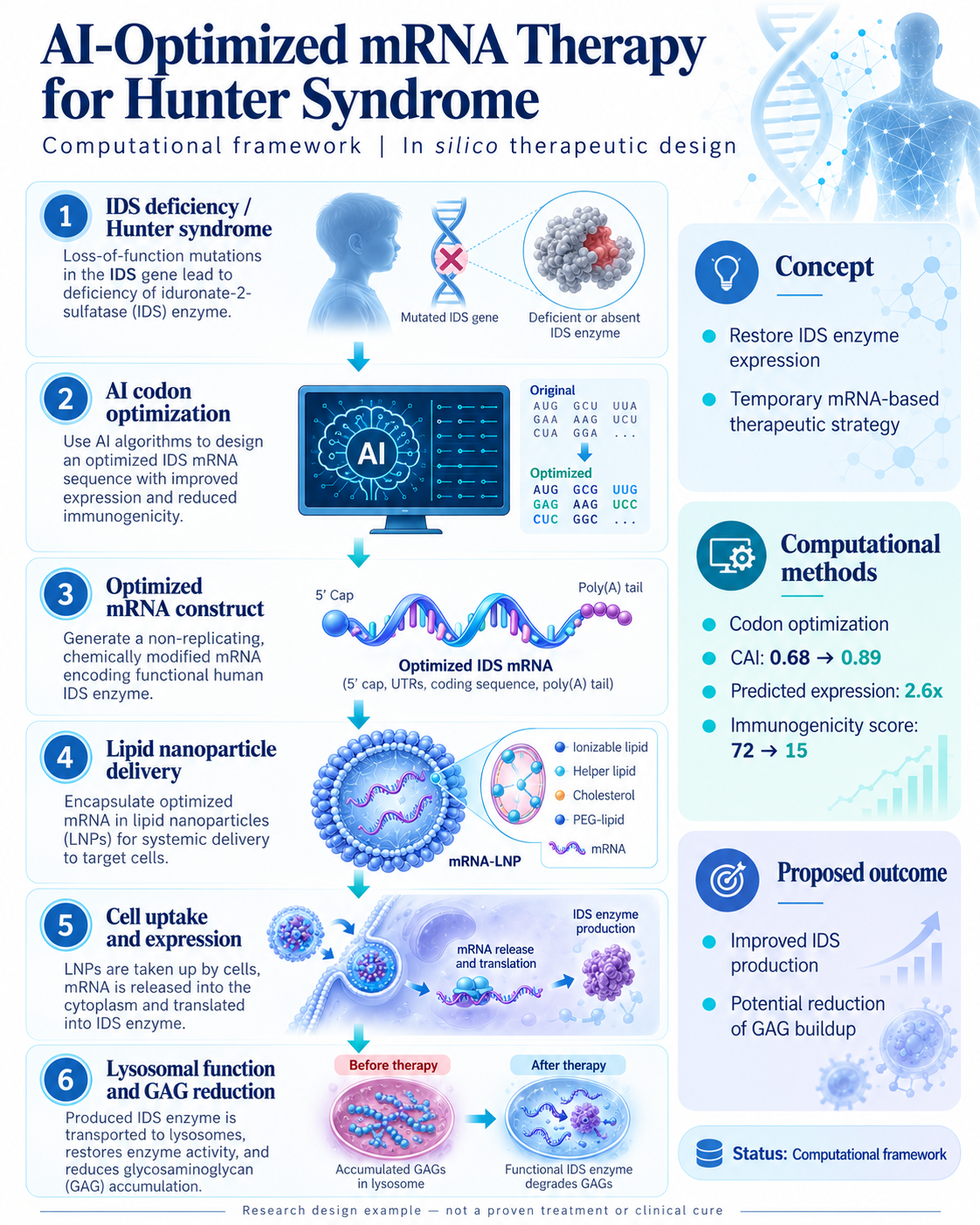
Original uploaded scientific infographic — use the Enlarge button for a full-size view.
Design Process
- 1
Disease characterization — IDS gene deficiency and the resulting enzyme loss are mapped as the design target.
- 2
AI codon optimization — algorithms design an optimized IDS mRNA sequence with improved expression and reduced predicted immunogenicity.
- 3
Optimized mRNA construct — generate a non-replicating, chemically modified mRNA (5′ cap, UTRs, coding sequence, poly(A) tail) encoding functional human IDS.
- 4
Lipid nanoparticle formulation — encapsulate the optimized mRNA in LNPs (ionizable lipid, helper lipid, cholesterol, PEG-lipid) for systemic delivery.
- 5
Cell uptake & expression modeling — model LNP uptake, cytosolic mRNA release, translation and IDS enzyme production.
- 6
Lysosomal function analysis — model IDS transport to lysosomes and degradation of accumulated GAGs.
Proposed Biological Mechanism
- 1
LNPs carrying the optimized IDS mRNA are taken up by target cells.
- 2
The mRNA is released into the cytosol and translated into functional IDS enzyme.
- 3
Produced IDS enzyme is transported to lysosomes.
- 4
Restored enzyme activity degrades accumulated glycosaminoglycans (GAGs).
- 5
The predicted outcome is improved IDS production and a potential reduction of GAG buildup — a computational prediction only, not a demonstrated clinical effect.
All steps describe intended, modeled or proposed behavior — no effect above is experimentally proven or clinically demonstrated.
Mathematical Analysis
Codon adaptation index (CAI)
0.68 → 0.89 (+31%)
Predicted CAI of the lead candidate (Variant E) compared with the native IDS sequence.
Predicted expression
2.6× (95% CI 2.1–3.2)
Model-predicted IDS expression relative to the native sequence. The prediction model reports 5-fold cross-validation R² = 0.78 ± 0.04. It is not a laboratory measurement.
Innate immunogenicity score
72/100 → 15/100 (−79%)
Composite computational score (TLR7/8, RIG-I, PKR); lower means lower predicted innate immunogenicity.
GC content
52.3% → 54.8%
GC content of the native versus optimized coding design.
Construct size
1,650 nt CDS · 2,090 nt total
Optimized IDS coding sequence length and the complete designed construct (5′ UTR, Kozak, CDS, 3′ UTR, poly(A) A120).
Predicted HLA population coverage is a computational prediction of epitope presentation — it is not a measure of actual vaccine protection. All values originate from the supplied manuscript materials.
FASTA Sequence Viewer
FASTA — 2 sequences
Partial view: only the short regulatory elements printed in the manuscript are shown. The full Native IDS and Variant E construct FASTA (Supplementary File 1) remains private. Sequences are theoretical designs.
> Variant_E_5UTR_Optimized_96nt (RNA)
Length: 99 characters
> Kozak_Sequence (RNA)
Length: 9 characters
Original Scientific Manuscript
Read-only viewing
The original manuscript PDF is available below for read-only viewing only. Downloading, copying or redistribution is not permitted without written permission from Alkhaleeli BioAI LLC.
© Alkhaleeli BioAI LLC. All rights reserved. This manuscript is the intellectual property of Alkhaleeli BioAI LLC and is provided for read-only viewing only. Downloading, copying, printing, redistribution, or any other use — in whole or in part — requires prior written permission from Alkhaleeli BioAI LLC.
Scientific Status
Hunter Syndrome — Computational framework
These projects are scientific research designs and computational proof-of-concept studies. They are not approved medical products, experimentally validated cures, or guarantees of therapeutic effectiveness.