Malaria — PvRBP3 mRNA Vaccine Candidate
Research ownership & attribution: Rami M. Alkhaleeli — Alkhaleeli BioAI LLC
Scientific Concept
Plasmodium vivax malaria depends on reticulocyte invasion mediated by parasite proteins such as reticulocyte-binding protein 3 (PvRBP3). This design targets PvRBP3 as the vaccine antigen: immunogenic B-cell and T-cell epitopes are predicted on the PvRBP3 protein, linked into a multi-epitope construct, and encoded in a codon-optimized mRNA of 1,253 nucleotides for conceptual lipid nanoparticle delivery. The aim is broad antigen recognition of a key invasion protein within a Plasmodium vivax vaccine research framework.
Scientific Diagram
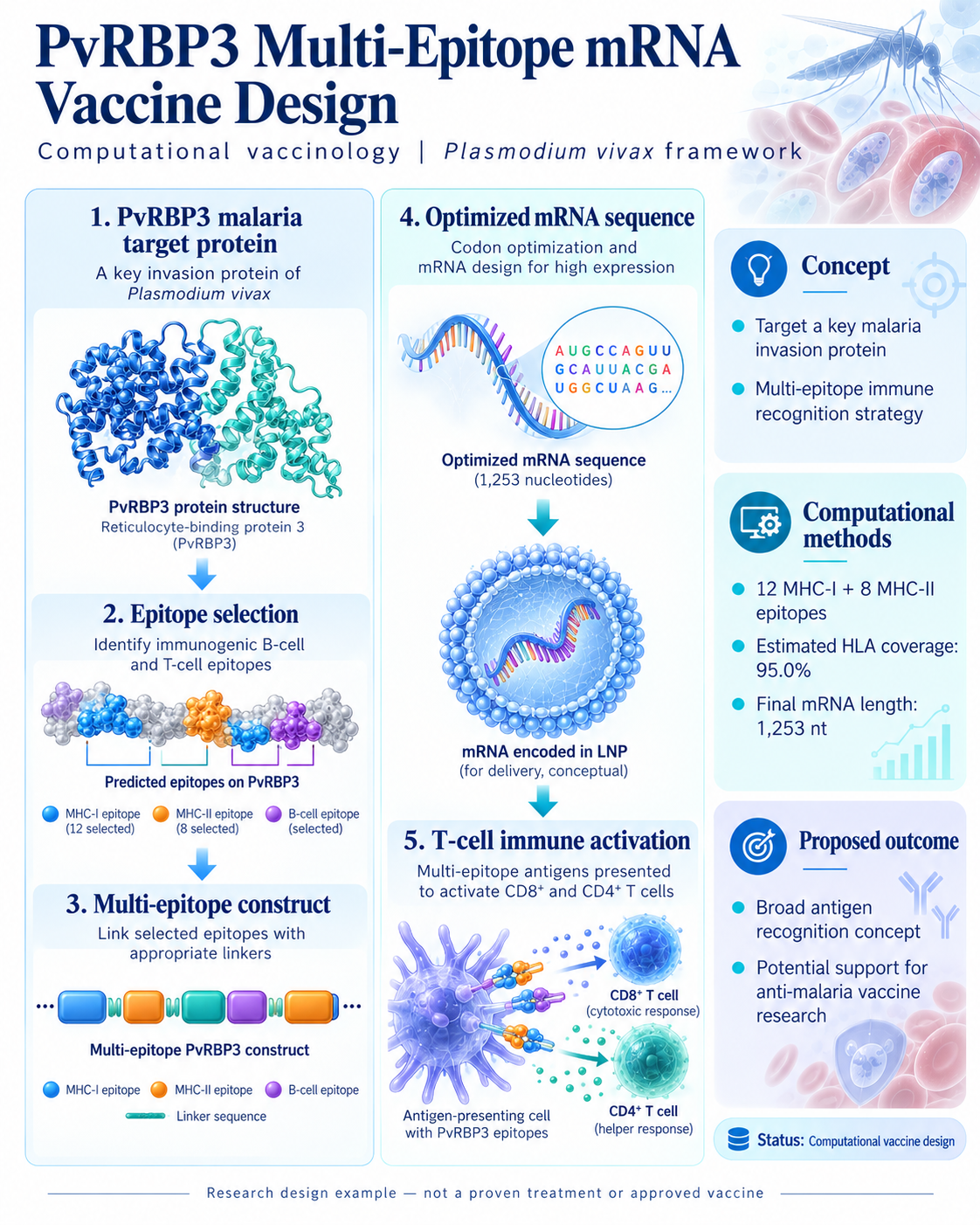
Original uploaded scientific infographic — use the Enlarge button for a full-size view.
Design Process
- 1
Target selection — PvRBP3, a key invasion protein of Plasmodium vivax, is chosen as the vaccine target protein.
- 2
Epitope selection — identify immunogenic B-cell and T-cell epitopes on PvRBP3 (12 MHC-I selected, 8 MHC-II selected, plus B-cell epitopes).
- 3
Multi-epitope construct — link selected epitopes with appropriate linker sequences into a multi-epitope PvRBP3 construct.
- 4
Codon optimization & mRNA design — optimize the coding sequence and finalize the mRNA design for high predicted expression (1,253 nt).
- 5
Formulation concept — conceptual mRNA encapsulation in an LNP for delivery.
- 6
Immune activation modeling — model multi-epitope antigen presentation activating CD8+ (cytotoxic) and CD4+ (helper) T cells.
Proposed Biological Mechanism
- 1
The codon-optimized multi-epitope mRNA is delivered (conceptually) in an LNP.
- 2
Host antigen-presenting cells translate the mRNA and present PvRBP3 epitopes.
- 3
CD8+ T cells recognize MHC-I presented epitopes and mount a modeled cytotoxic response.
- 4
CD4+ T cells recognize MHC-II presented epitopes and provide a modeled helper response.
- 5
The predicted outcome is broad antigen recognition of a key malaria invasion protein — potential support for anti-malaria vaccine research, not a proven or approved vaccine.
All steps describe intended, modeled or proposed behavior — no effect above is experimentally proven or clinically demonstrated.
Mathematical Analysis
Target antigen
PvRBP3 · 2,797 aa
Plasmodium vivax reticulocyte-binding protein 3 (GenBank QDH08878.1); VaxiJen antigenicity score 0.755 (probable antigen, threshold > 0.5).
Epitope count
12 MHC-I + 8 MHC-II
Selected from 549 strong MHC-I and 102 strong MHC-II predicted binders (84,356 and 13,915 total predictions).
Estimated global HLA coverage
95.0%
Computational estimate only. The manuscript notes direct coverage of 2 of 8 MHC-I and 4 of 5 MHC-II panel alleles. It is not a measure of vaccine protection.
Final mRNA length
1,253 nt
Complete designed mRNA: 999 nt coding sequence, 333-aa epitope cassette, plus UTRs and a 110-nt poly(A) tail.
Predicted HLA population coverage is a computational prediction of epitope presentation — it is not a measure of actual vaccine protection. All values originate from the supplied manuscript materials.
FASTA Sequence Viewer
FASTA — 1 sequence
Epitope cassette protein sequence (including tPA signal peptide) as printed in the manuscript. The 1,253-nt mRNA is not reproduced here.
> PvRBP3_epitope_cassette_with_signal_peptide
Length: 333 characters
Original Scientific Manuscript
Read-only viewing
The original manuscript PDF is available below for read-only viewing only. Downloading, copying or redistribution is not permitted without written permission from Alkhaleeli BioAI LLC.
© Alkhaleeli BioAI LLC. All rights reserved. This manuscript is the intellectual property of Alkhaleeli BioAI LLC and is provided for read-only viewing only. Downloading, copying, printing, redistribution, or any other use — in whole or in part — requires prior written permission from Alkhaleeli BioAI LLC.
Scientific Status
Malaria — Computational vaccine design
These projects are scientific research designs and computational proof-of-concept studies. They are not approved medical products, experimentally validated cures, or guarantees of therapeutic effectiveness.