HIV — Personalized mRNA Vaccine Design
Research ownership & attribution: Rami M. Alkhaleeli — Alkhaleeli BioAI LLC
Scientific Concept
HIV mutates rapidly, making one-size-fits-all vaccine design difficult. This in-silico proof of concept models a personalized workflow: the patient-derived HIV envelope (env) sequence is analyzed, CD8 and CD4 T-cell epitopes are predicted from the patient-specific HLA type and env sequence, a patient-specific Env trimer immunogen is designed incorporating the predicted epitopes with native-like structure, and a codon-optimized mRNA encoding the personalized immunogen is modeled for LNP delivery. Evaluation used a synthetic cohort of 20 modeled patients and agent-based immune simulation.
Scientific Diagram
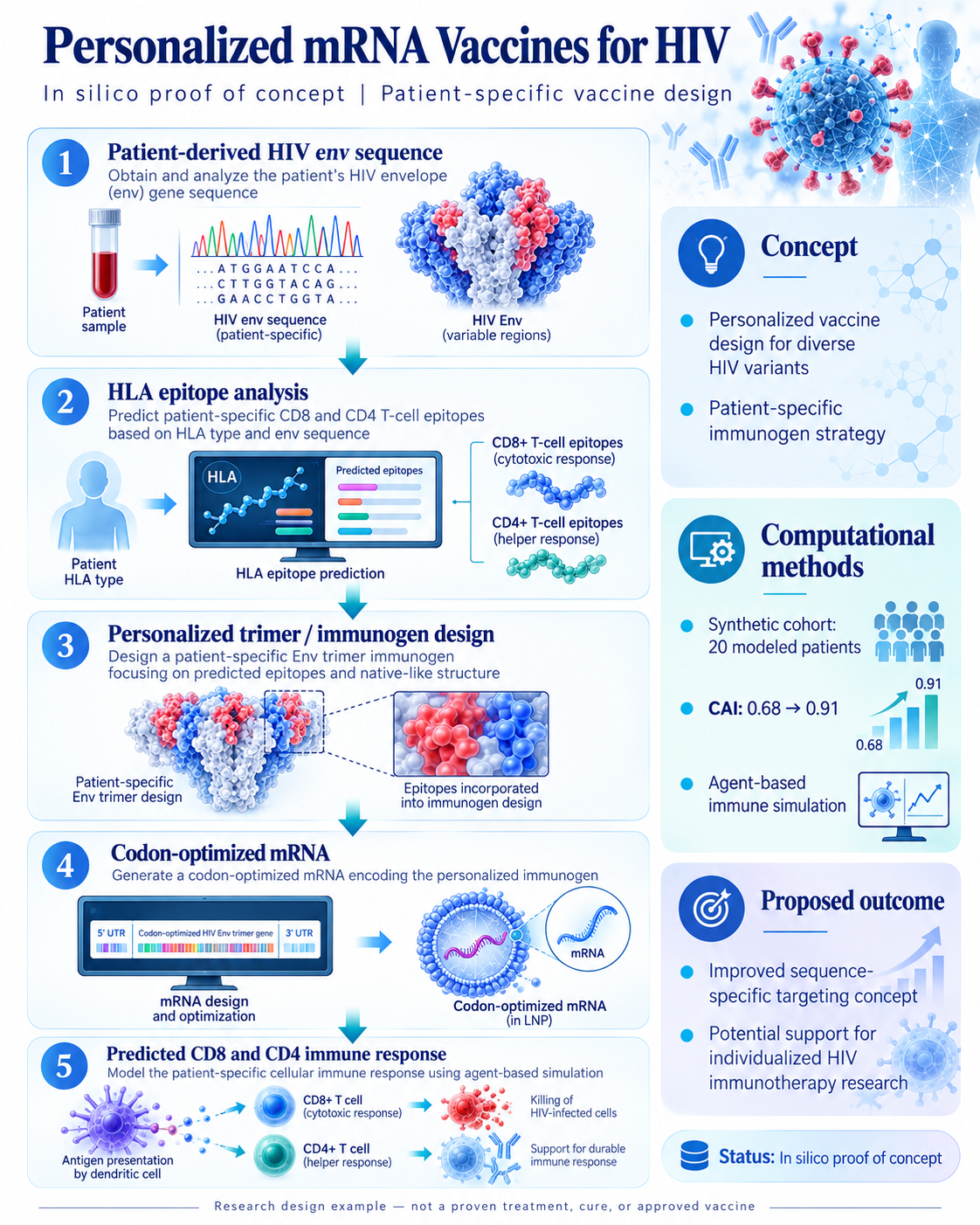
Original uploaded scientific infographic — use the Enlarge button for a full-size view.
Design Process
- 1
Patient-derived HIV env sequence — obtain and analyze the patient-specific envelope gene sequence.
- 2
HLA epitope analysis — predict patient-specific CD8 and CD4 T-cell epitopes based on HLA type and env sequence.
- 3
Personalized trimer / immunogen design — design a patient-specific Env trimer immunogen focusing on predicted epitopes and native-like structure.
- 4
Codon-optimized mRNA — generate a codon-optimized mRNA encoding the personalized immunogen (5′ UTR, codon-optimized HIV Env trimer gene, 3′ UTR) for conceptual LNP delivery.
- 5
Immune response modeling — model the patient-specific cellular immune response using agent-based simulation.
Proposed Biological Mechanism
- 1
The personalized Env immunogen mRNA is translated by antigen-presenting cells.
- 2
Dendritic cells present patient-specific HIV Env epitopes.
- 3
CD8+ T cells are modeled to mount a cytotoxic response against HIV-infected cells.
- 4
CD4+ T cells are modeled to support a durable immune response.
- 5
The predicted outcome is an improved sequence-specific targeting concept for individualized HIV immunotherapy research — an in-silico model only, not a proven treatment, cure or approved vaccine.
All steps describe intended, modeled or proposed behavior — no effect above is experimentally proven or clinically demonstrated.
Mathematical Analysis
Modeled cohort
20 synthetic patients
Entirely synthetic multidrug-resistant HIV-1 patients; no real patient data or laboratory experiments.
Codon adaptation index (CAI)
0.68 → 0.91
Median CAI before and after codon optimization (p < 0.001, Wilcoxon).
Construct length
Median 2,547 nt (2,511–2,589)
Patient-specific mRNAs encoding full-length gp160 with a median of 28 patient-specific substitutions.
Predicted epitopes per patient
47 MHC-I · 89 MHC-II (medians)
Predicted strong binders (<500 nM). Only 12 epitopes were predicted to be shared across all 20 patients.
Simulated peak CD8+ response
Median 8,450 cells/µL
Agent-based simulation after a three-dose schedule (days 0, 28, 56). These are model predictions, not measurements in people.
Predicted HLA population coverage is a computational prediction of epitope presentation — it is not a measure of actual vaccine protection. All values originate from the supplied manuscript materials.
FASTA Sequence Viewer
Complete sequence not available
Complete sequence not available in the supplied manuscript. Sequences are never generated as replacements — the original sequence files remain private until the author authorizes public access.
Original Scientific Manuscript
Read-only viewing
The original manuscript PDF is available below for read-only viewing only. Downloading, copying or redistribution is not permitted without written permission from Alkhaleeli BioAI LLC.
© Alkhaleeli BioAI LLC. All rights reserved. This manuscript is the intellectual property of Alkhaleeli BioAI LLC and is provided for read-only viewing only. Downloading, copying, printing, redistribution, or any other use — in whole or in part — requires prior written permission from Alkhaleeli BioAI LLC.
Scientific Status
HIV — In silico proof of concept
These projects are scientific research designs and computational proof-of-concept studies. They are not approved medical products, experimentally validated cures, or guarantees of therapeutic effectiveness.