Clostridial α-Toxin — mRNA-Based Hydrogel Therapeutic Concept
Research ownership & attribution: Rami M. Alkhaleeli — Alkhaleeli BioAI LLC
Scientific Concept
Contaminated wounds at risk of Clostridium perfringens infection suffer tissue injury driven by clostridial α-toxin. This conceptual framework proposes a stage-adaptive, injectable thermogelling hydrogel platform: an mRNA-encoded α-toxin inhibitor plus MgO nanoparticles are embedded in a thermoresponsive hydrogel that forms in situ at the wound site. The molecular target is the clostridial α-toxin, which the locally expressed inhibitor is designed to bind and neutralize — an adjunct, localized wound-therapy research design, not a proven treatment or substitute for standard medical care.
Scientific Diagram
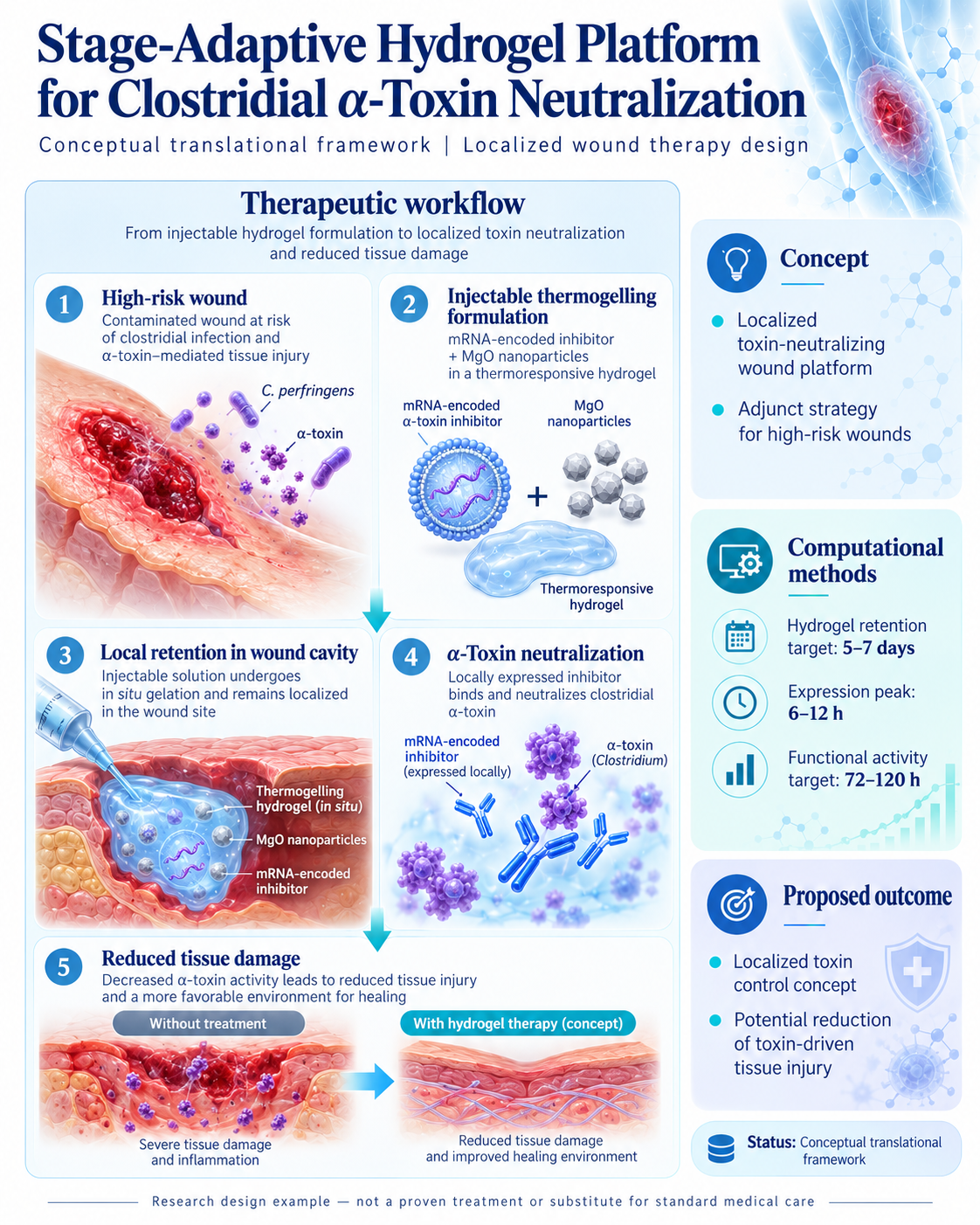
Original uploaded scientific infographic — use the Enlarge button for a full-size view.
Design Process
- 1
High-risk wound definition — characterize contaminated wounds at risk of α-toxin–mediated tissue injury by C. perfringens.
- 2
Injectable thermogelling formulation — combine an mRNA-encoded inhibitor and MgO nanoparticles in a thermoresponsive hydrogel.
- 3
Local retention design — the injectable solution undergoes in-situ gelation and remains localized in the wound cavity.
- 4
α-Toxin neutralization design — locally expressed inhibitor binds and neutralizes clostridial α-toxin.
- 5
Tissue-protection modeling — model reduced α-toxin activity leading to decreased tissue damage and a more favorable healing environment.
Proposed Biological Mechanism
- 1
The thermogelling formulation is injected into the wound cavity and gels in situ.
- 2
MgO nanoparticles and the mRNA-encoded inhibitor remain locally retained (retention target 5–7 days).
- 3
Host cells at the wound site translate the mRNA, with expression peaking at 6–12 h.
- 4
The locally expressed inhibitor binds and neutralizes clostridial α-toxin (functional activity target 72–120 h).
- 5
Reduced α-toxin activity is modeled to lessen tissue injury and create a more favorable healing environment — a conceptual framework only, not a demonstrated therapy.
All steps describe intended, modeled or proposed behavior — no effect above is experimentally proven or clinically demonstrated.
Mathematical Analysis
Hydrogel retention target
5–7 days
Design target for how long the in-situ gel is intended to remain localized in the wound cavity.
Expression peak
6–12 h
Design target for when locally expressed inhibitor levels are expected to peak after gelation — a design specification, not a measured value.
Functional activity target
72–120 h
Design target for the intended duration of functional α-toxin-neutralizing activity of the locally expressed inhibitor.
Predicted HLA population coverage is a computational prediction of epitope presentation — it is not a measure of actual vaccine protection. All values originate from the supplied manuscript materials.
FASTA Sequence Viewer
Complete sequence not available
Complete sequence not available in the supplied manuscript. Sequences are never generated as replacements — the original sequence files remain private until the author authorizes public access.
Original Scientific Manuscript
Manuscript — Private by default
The original manuscript for this design is kept private by default. Public preview and download remain disabled until the author approves access.
Request manuscript access via the collaboration contactScientific Status
Clostridial α-Toxin — Conceptual translational framework
These projects are scientific research designs and computational proof-of-concept studies. They are not approved medical products, experimentally validated cures, or guarantees of therapeutic effectiveness.