Cordyceps-Like Fungal Pathogen — Hypothetical mRNA Vaccine
Research ownership & attribution: Rami M. Alkhaleeli — Alkhaleeli BioAI LLC
Scientific Concept
This project is a HYPOTHETICAL COMPUTATIONAL EXERCISE: the "Cordyceps-like pathogen" is an imaginary fungal pathogen with conceptual immunogenic proteins. It does not exist as a characterized human pathogen. The exercise demonstrates a complete systems-vaccinology workflow — from pathogen proteome to antigen selection, epitope mapping, multi-epitope mRNA construct design and immune activation modeling — as a potential framework for future fungal vaccine research. No real organism, outbreak or clinical target is involved.
Scientific Diagram
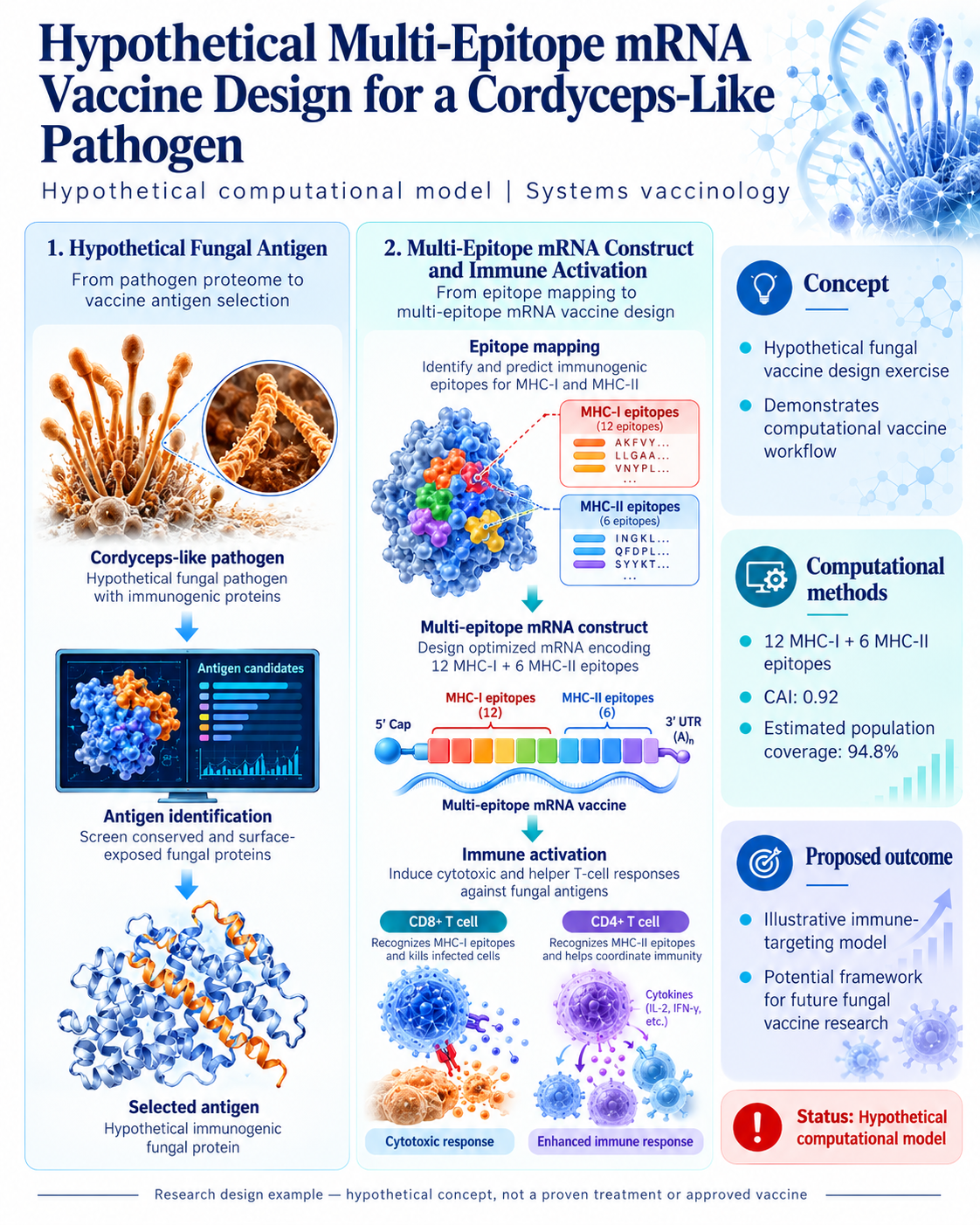
Original uploaded scientific infographic — use the Enlarge button for a full-size view.
Design Process
- 1
Hypothetical fungal antigen — define an imaginary Cordyceps-like pathogen with immunogenic proteins and screen conceptual conserved and surface-exposed fungal proteins as antigen candidates.
- 2
Antigen identification — select a conceptual immunogenic fungal protein as the antigen.
- 3
Epitope mapping — predict immunogenic MHC-I and MHC-II epitopes for the conceptual antigen (12 MHC-I epitopes, 6 MHC-II epitopes).
- 4
Multi-epitope mRNA construct — design an optimized mRNA encoding the 12 MHC-I and 6 MHC-II epitopes with 5′ cap and 3′ UTR/poly(A) elements.
- 5
Immune activation modeling — model CD8+ (cytotoxic) and CD4+ (helper) T-cell responses against the conceptual fungal epitopes.
Proposed Biological Mechanism
- 1
The conceptual multi-epitope mRNA would be translated by host antigen-presenting cells (modeled).
- 2
Conceptual fungal MHC-I and MHC-II epitopes would be processed and presented.
- 3
CD8+ T cells are modeled to recognize MHC-I epitopes and kill MHC-I-presenting cells.
- 4
CD4+ T cells are modeled to recognize MHC-II epitopes and coordinate cytokine-driven immune responses (IL-2, IFN-γ etc.).
- 5
This is an illustrative immune-targeting model and a potential framework for future fungal vaccine research — entirely hypothetical, not a proven treatment or approved vaccine.
All steps describe intended, modeled or proposed behavior — no effect above is experimentally proven or clinically demonstrated.
Mathematical Analysis
Epitope count
12 MHC-I + 6 MHC-II
The hypothetical construct incorporates 12 predicted MHC class I epitopes and 6 predicted MHC class II epitopes.
Codon adaptation index (CAI)
0.92
The hypothetical construct was assigned a predicted CAI of 0.92, indicating a coding sequence well matched to efficient host translation in the model.
Estimated population coverage
94.8%
Estimated HLA population coverage of the conceptual epitopes — a computational prediction only, not a measure of actual protection.
Predicted HLA population coverage is a computational prediction of epitope presentation — it is not a measure of actual vaccine protection. All values originate from the supplied manuscript materials.
FASTA Sequence Viewer
Complete sequence not available
Complete sequence not available in the supplied manuscript. Sequences are never generated as replacements — the original sequence files remain private until the author authorizes public access.
Original Scientific Manuscript
Manuscript — Private by default
The original manuscript for this design is kept private by default. Public preview and download remain disabled until the author approves access.
Request manuscript access via the collaboration contactScientific Status
Cordyceps-Like Fungal Pathogen — Hypothetical computational model
These projects are scientific research designs and computational proof-of-concept studies. They are not approved medical products, experimentally validated cures, or guarantees of therapeutic effectiveness.